
Our news
THERMAL INTERFACE SOLUTIONS: how to choose the right one?
In electronics, managing heat inside enclosures is a major challenge. The thermal dissipation interfaces plays a key role here, but choosing the right material depends as much on technical criteria as on the intended application.
How does a thermal interface work?
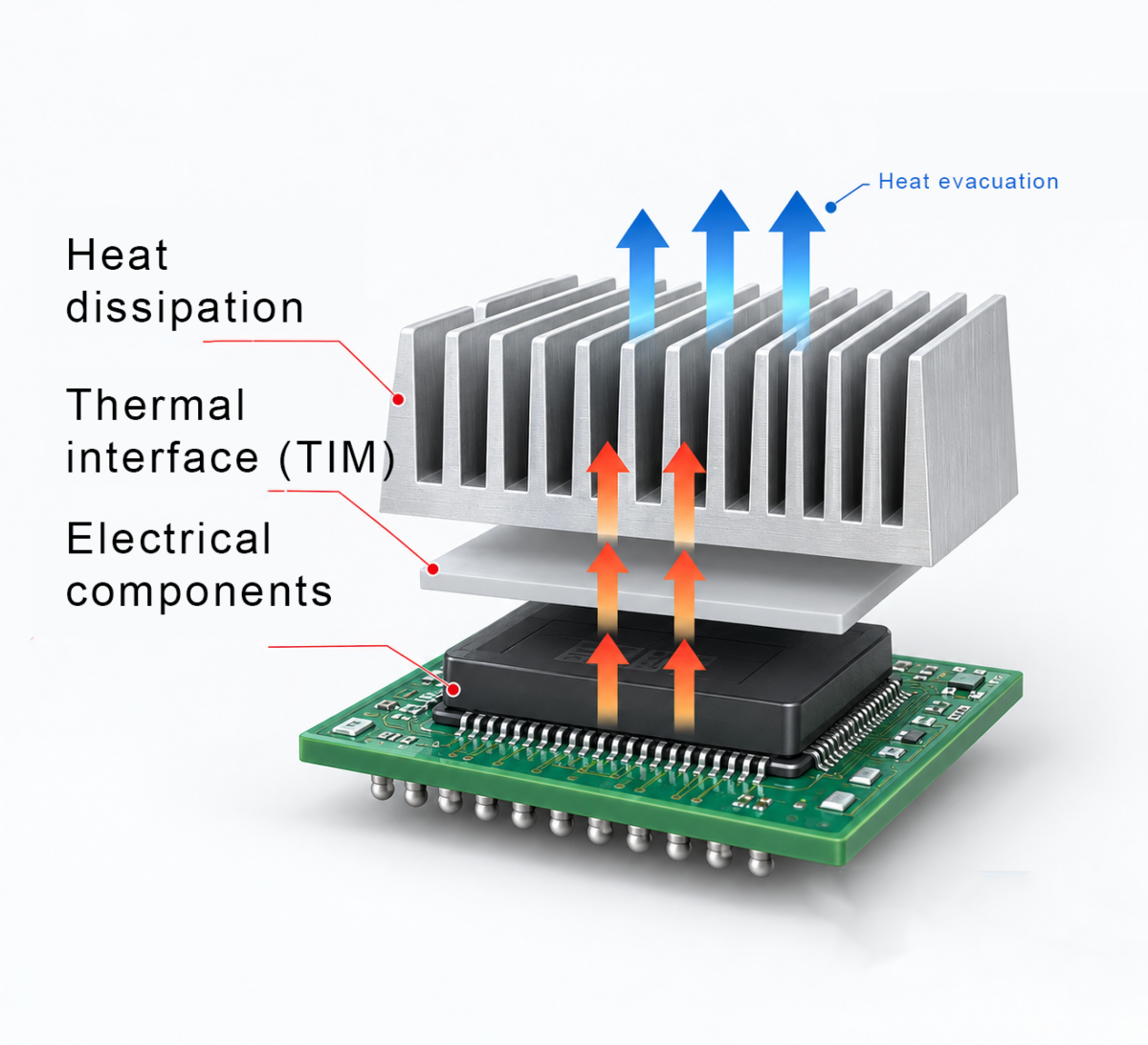
A thermal interface material (TIM, Thermal Interface Material) fills in the micro-irregularities on the contacting surfaces. It thereby reduces the thermal resistance between the component and the heat sink, and facilitates heat dissipation.
What criteria should you consider when choosing one?
– Thermal conductivity (W/m·K) measures a material’s ability to transfer heat.
– The thickness must be sufficient to compensate for the gap between the surfaces; the greater the thickness, the higher the thermal resistance will be.
– Hardness and compressibility determine the material’s ability to conform to irregularities.
– The temperature range ensures stability under actual conditions of use.
– Thermal resistance and contact resistance enable the overall performance of the interface to be assessed.
However, high thermal conductivity does not necessarily mean better performance: it’s the combination of all these criteria, in real-world conditions, that makes the difference.
The GERGOTIM range
To meet the heat dissipation requirements of your applications, our Gergotim range offers two product families:
- Silicone thermal pads (TSI): Compressible interface, without silicone oil, tacky on both sides, resistant to high temperatures (up to 200°C). Available in different hardnesses and thermal conductivites.
- HTP acrylic thermal adhesive tapes : Double-sided adhesive tapes which combines electrical insulation and high conformability. Manage heat in electronic and automotive market. Range includes 4 standard references