Choosing between silicone gel and acrylic
Silicone gel or acrylic: How to choose the right adhesive for your medical device?
Whether it’s a bandage, patch, monitoring device, or infusion set—whenever a medical device needs to stick to the skin, a question arises: Should you choose silicone gel or acrylic? There is no one-size-fits-all answer: the choice always depends on the device’s intended use. Yet this is a decision that carries significant weight in product design. An improperly chosen adhesive can compromise the device’s adhesion, cause irritation, or even make removal painful for the patient—all factors that directly impact the patient experience and the perceived quality of the device. Conversely, a well-chosen adhesive goes unnoticed: it stays in place for as long as needed, without causing discomfort or any surprises upon removal. At Gergonne, we have been supporting manufacturers on this issue for over fifteen years, with expertise spanning both technologies.
Four questions to ask yourself before choosing
1) Where will the patch be applied?
An eyelid, the neck, or any other sensitive area presents specific challenges: the skin there is thinner, and therefore more delicate and more prone to irritation or marks when the patch is removed, and these areas are often more mobile or exposed to friction (the neck, neck movements, blinking). An adhesive that works well elsewhere may therefore prove too harsh on these areas.
2) What is the size of the device and its adhesive surface area?
The larger the adhesive surface, the greater the total holding force—which is useful for stability but can sometimes be uncomfortable or painful upon removal if the adhesive isn’t gentle enough for that surface. Conversely, a small device often needs to compensate for its small surface area with stronger adhesion per square centimeter. Finding the right balance between hold and comfort depends directly on this surface-to-force ratio.
3) How long will the patient wear it?
The longer the wear time, the more critical long-term durability becomes—and this is often where acrylic has the advantage: it adheres more strongly and remains stable over time. However, on sensitive skin, this strong adhesion can become a problem during removal. In such cases, a balance must be struck between the two technologies, or even a preference given to silicone gel—even for long-term wear—if the patient’s skin is sensitive. Moreover, skin fragility isn’t always apparent from the start: healthy skin can tolerate the application of an acrylic adhesive just once. It’s the repeated use that changes the situation. In areas where the adhesive is applied and removed regularly—as is typically the case with adhesives for chronic wounds—the skin gradually weakens due to repeated stress, and silicone gel then becomes the preferred choice.
4) Who is the patient?
A very active or athletic patient puts stress on the adhesive through perspiration and repeated movements, which requires good shear strength. Pediatric and geriatric patients, on the other hand, have thinner, more reactive skin: the risk of skin damage upon removal is higher in these cases, which calls for gentler adhesives, even if it means sacrificing some holding power.
In practice, it is rarely a single criterion that determines the choice: it is the combination of all four that guides the selection of the right balance between adhesion, comfort, and skin safety.
Silicone gel: a Gergonne specialty
At Gergonne, we offer several silicone gel formulations with different application weights (the thickness of the applied gel) to meet the specific needs of each device as closely as possible.
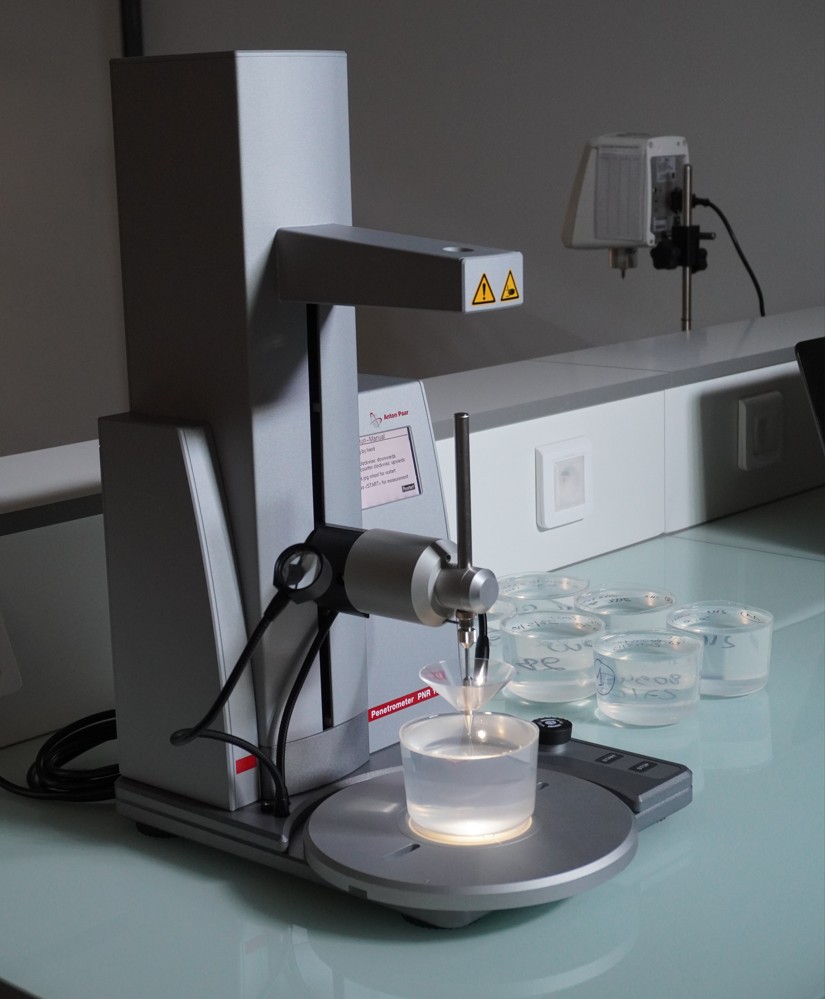
But offering multiple formulations isn’t enough—each batch must perform exactly like the one before it. That’s where our quality control comes into play. We have the necessary analytical tools to minimize performance variations from one production run to the next and ensure reliable, repeatable adhesion.
We also perforate the products in-house, which makes them more breathable—a real plus for patient comfort, especially during prolonged wear.
One final point, often underestimated: the liner. With silicone gel, the level of adhesion changes over time when in contact with the liner. Some liner/gel combinations age well, while others do not. That’s why choosing the right liner is an integral part of our consultation—not just an afterthought.
Acrylic: equally solid expertise
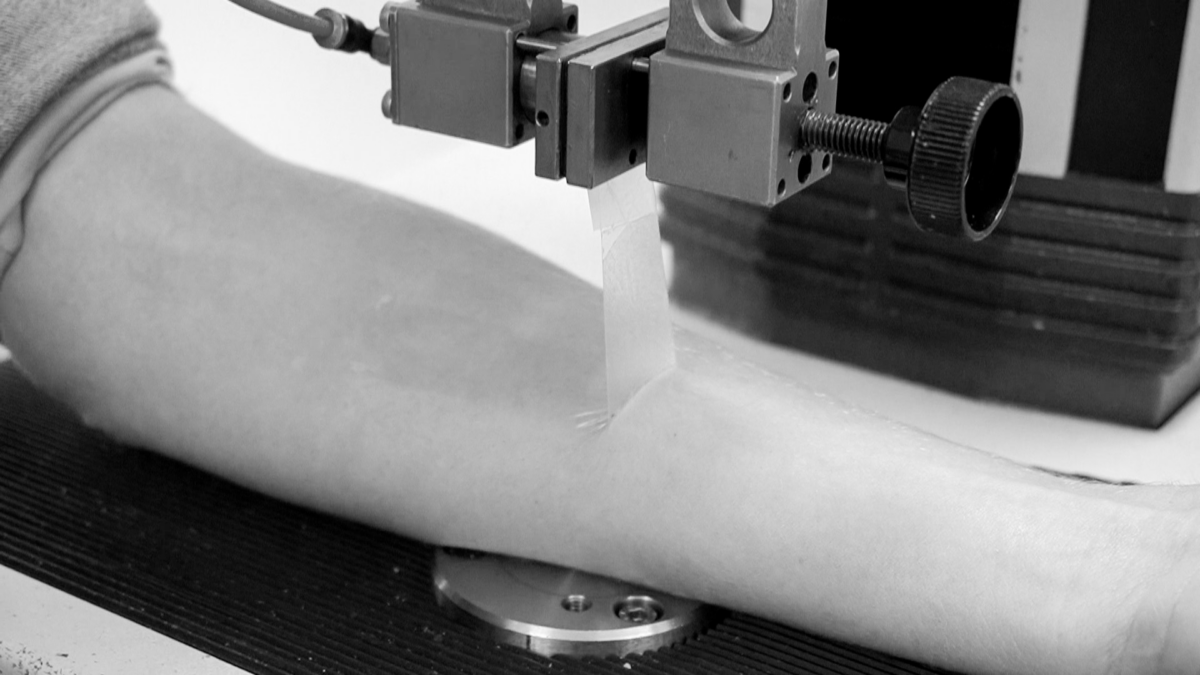
Acrylic remains a key choice in many applications, particularly when the priority is strong, immediate adhesion or long-lasting hold on healthy skin. This technology offers high tack upon contact, with good durability over time, even in humid environments or when subjected to repeated movement—a key advantage for devices that must remain in place without repositioning.
At Gergonne, we also coat our acrylic adhesives in-house, applying the same high standards as we do for silicone: multiple levels of bonding strength are available, and rigorous quality control ensures consistent performance from one batch to the next.
Why not both?
For certain applications, the best solution isn’t to choose between silicone and acrylic, but to offer both: a silicone gel version for sensitive skin, and an acrylic version for skin that tolerates strong adhesion well. One device, two versions, a single partner who masters both technologies.
That’s exactly what we offer at Gergonne: no technological bias, but objective advice on what’s best for each specific application—including when the answer is “both.”
This approach already exists on the market: the Nephrokit line offers its Solukat product in two versions—a standard version for skin that bonds easily, and a Solukat SI version, made of silicone gel, for sensitive skin. Two versions, one function, tailored to two different patient profiles.
In summary
Choosing between silicone gel and acrylic is not a matter of technical preference—it is a matter of intended use. The area of the body, the duration of wear, and the patient all influence the decision. Moreover, the choice is not limited to the adhesive alone: the substrate onto which it is applied also influences its final properties and deserves to be selected with the same care. At Gergonne, we offer dual expertise in silicone and acrylic, genuine know-how regarding liner/adhesive combinations, and industrial capabilities (formulation, basis weights, perforation) that guarantee consistent performance over time—and we also assist our clients in selecting the most suitable substrate for their device.
Are you developing an adhesive medical device and wondering which technology to choose? Let’s discuss it with our teams.