Gergonne, a European manufacturer of thermal interfaces
Thermal interfaces : Why you should take back control of your supply chain
Thermal management of electronic components increasingly relies on thermal interface materials (TIMs)—such as silicone pads and thermally conductive adhesive tapes—a large portion of the global supply of which now comes from Asia. For a design office or purchasing department, this geographic dependence raises an issue that goes beyond purchase price alone: that of industrial sovereignty over components that directly determine the reliability of finished products. Partnering with a European manufacturer of thermal interfaces allows you to address this very issue.
Industrial sovereignty: a matter of control, not just of origin
Relying on a supplier located several weeks’ shipping time away for a critical component means accepting risks beyond your control: variability in ocean freight lead times, customs issues, and production decisions made by the factory based on its own priorities rather than yours. For an automotive or embedded electronics manufacturer, a delay of several weeks for a thermal pad can be enough to shut down an entire production line.
Choosing a European manufacturer means reintegrating that component into a supply chain that you can audit, visit, and develop together with your supplier—rather than simply enduring it from afar. At Gergonne, the design and production of Gergotim thermal pads and thermally conductive adhesive tapes take place in France: the traceability of each batch is documented locally, which also simplifies quality audits and regulatory compliance requirements (REACH, RoHS) that are increasingly scrutinized by clients.
Vertical integration that goes beyond local assembly
This expertise is not limited to a geographic location: it is based on the vertical integration of the entire manufacturing process. Unlike a converter, which merely processes or assembles materials already formulated elsewhere, Gergonne controls and manages the bulk of the value chain: formulation, coating, and cutting. This industrial continuity, consolidated at a single site, avoids the disruptions inherent in models where multiple subcontractors intervene
successively—each with its own lead times and production priorities.
It is this integration that makes possible, downstream, the responsiveness that an industrial client can expect: a manufacturerthat controls both R&D and production can adapt a product without relying on an additional intermediary—and without adding the delays and uncertainties associated with coordinating across multiple sites or countries.
Responsiveness: the true driver of competitiveness
Beyond the issue of dependency, it is the ability to react quickly that most tangibly sets a European partner apart. Adjusting hardness, thickness, or thermal conductivity during product development involves, with a distant supplier, another round-trip of samples and a validation cycle that often takes months. With a local, vertically integrated manufacturer, this adjustment can be made through direct technical exchanges and accelerated development.
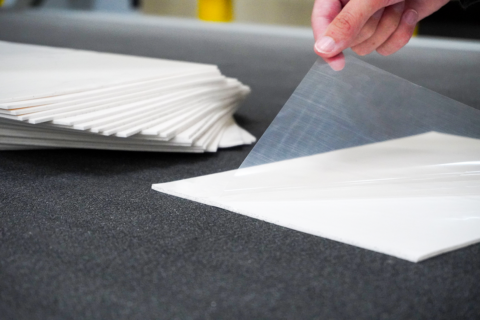
It is this responsiveness that allows a local manufacturer to move beyond the strict role of supplier and become a development partner. Our TSI silicone thermal pads are a prime example: formulated without silicone oil to prevent any risk of migration or contamination of adjacent surfaces, they are available in several levels of hardness and thermal conductivity (standard part numbers TSI-10,TSI-11, TSI-12), with the option to develop a specific thickness or
performance level tailored to your application—a custom solution made possible by direct involvement starting in R&D and continuing throughout the production process, from coating to cutting, and which, by its very nature, is faster to implement with a technical team that can be reached directly than with an intermediary located on the other side of the world.
Tacking back control, in practice
Industrial sovereignty, vertical integration, and responsiveness are therefore not three separate arguments, but different facets of the same choice: that of maintaining control over critical supplies rather than being at their mercy. For thermal interfaces, as with other strategic components, this choice translates very concretely into shorter development times, direct technical support, and the ability to secure production even in the event of unforeseen circumstances.
Would you like to evaluate a custom solution or assess your thermal
interface needs? Contact the Gergonne teams to speak directly
with our technical experts.
