Side Protect Technology
Side Protect Technology (patented): the VM16 membrane withstands high-pressure jets
An adhesive venting membrane allows air to pass through to equalize pressure and remove moisture, while blocking water, dust, and contaminants. This function becomes difficult to maintain when the housing is subjected to high-pressure cleaning or heavy water spray, such as on a vehicle. Gergonne has developed the VM16 model and its Side Protect technology to address these challenges.
The weakness of standard adhesive membranes
An ePTFE membrane is naturally hydrophobic: its microporous structure repels water but allows air and water vapor to pass through. This is what enables it to equalize pressures and remove moisture from an enclosure without letting in water or dust. However, this barrier has a limit: it can withstand only a certain water pressure, beyond which it no longer functions effectively. High-pressure cleaning, such as that used on a vehicle, concentrates a considerable force on a very small surface area in just a few seconds. Under these conditions, the risk does not come solely from the face of the membrane. An adhesive membrane is a multi-layer assembly attached to the housing, and its edges form the most exposed area: pressurized water can attempt to seep in from the sides. A standard membrane, designed primarily to ventilate through its surface, is not always built to withstand this type of stress. It is this weak point that Side Protect technology aims to mitigate.
How Side Protect works
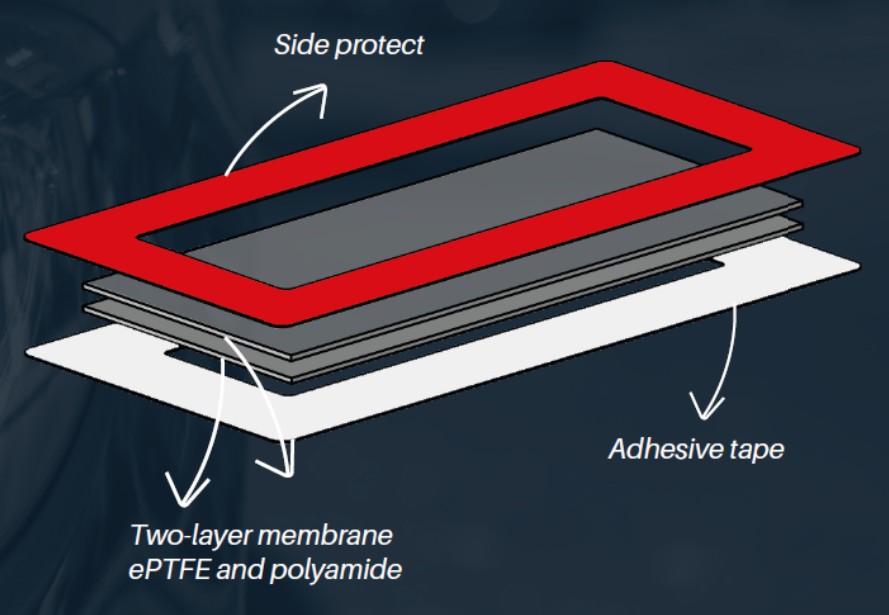
The VM16 consists of three components that work together. A two-layer membrane combines ePTFE—which provides breathability and a water-repellent barrier—with polyamide, which offers mechanical strength. A technical adhesive tape forms the interface with the shell: it ensures the membrane adheres securely and remains watertight, even under stress. Finally, Side Protect is a frame placed around the perimeter of the membrane, leaving the central ventilation area unobstructed. It protects the sides of the membrane—where high-pressure water jets could seep in—without reducing the ventilation area. This technology is patent-pending.
Performance of the VM16 ventilation membrane: airflow, watertightness, and resistance to 200 bar
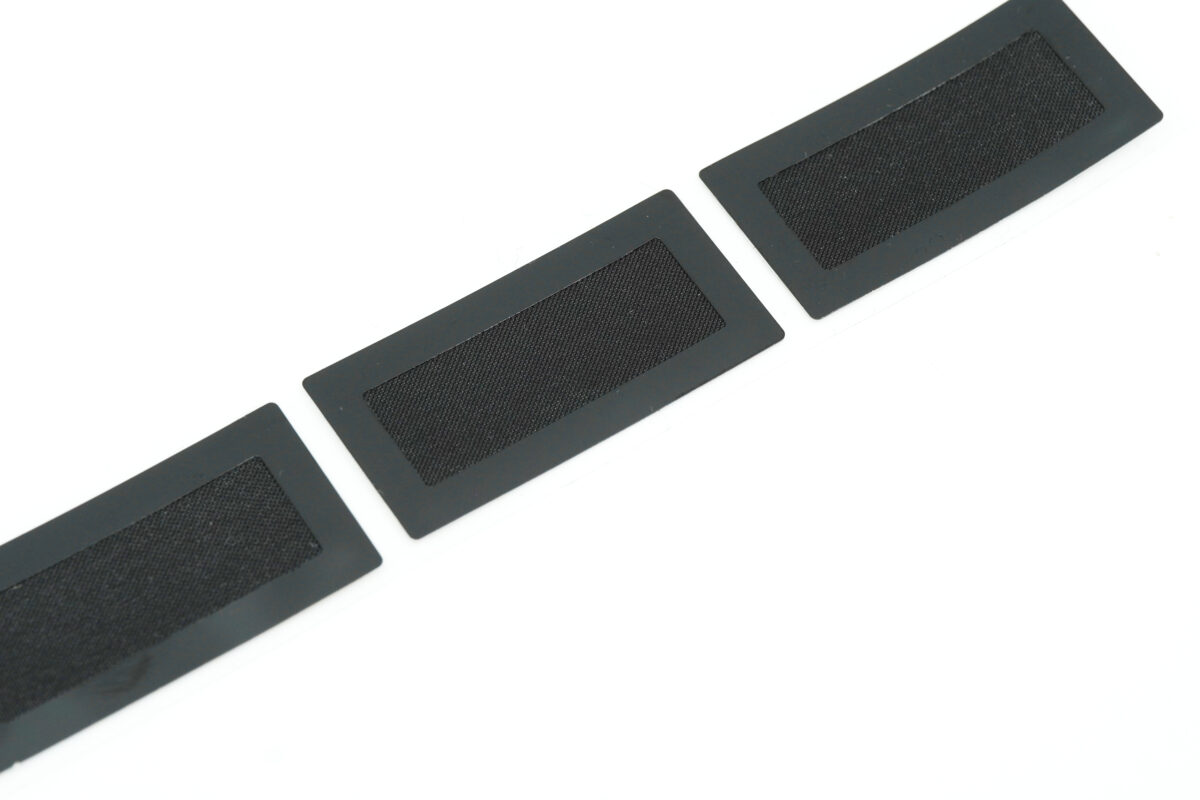
The VM16 venting membrane (part number VM16-RC01, black version) combines effective ventilation with enhanced watertightness. Its airflow rate, exceeding 250 ml/min/cm² at 70 mbar, quickly restores pressure balance within an enclosure, thereby protecting seals and minimizing condensation.
This ventilation is accompanied by excellent watertightness: the VM16’s water intrusion pressure is greater than or equal to 1 bar for 30 seconds. When subjected to high-pressure cleaning, the VM16 withstands a 200-bar water jet thanks to Side Protect technology, which protects the edges of the membrane. (This test is conducted using water at 20 °C (±10 °C), a flat spray at a 25° angle, with the nozzle positioned 50–60 cm away and angled 45° downward from the horizontal, for 5 seconds).
The VM16’s mechanical strength, exceeding 40 N, enhances the assembly’s durability, and its temperature range of -40 °C to 150 °C makes it suitable for automotive lighting, sensors, and onboard electronics.
VM16 and PFAS: 96% Less ePTFE with Equivalent Performance
ePTFE is a fluorinated material, and tightening regulations on PFAS are prompting manufacturers to reevaluate the amount of fluorinated material in their assemblies. The VM16 venting membrane offers a concrete solution: for identical ventilation performance and ventilation surface area, it uses 96% less ePTFE than equivalent membranes on the market. This reduction lowers material costs and minimizes the use of fluorinated materials, without compromising the ventilation performance or durability described above. For engineering firms looking to stay ahead of regulatory changes, the VM16 is therefore a strategic advantage that addresses both economic and regulatory considerations.
Like the entire GERGOVENT line, it is certified APFO-free.
Venting membrane for headlights: reducing fogging and protecting the optics
The headlight is one of the key applications for the VM16 venting membrane. A headlight is an enclosed housing that alternates between heating phases (when turned on, exposure to sunlight) and cooling phases (when turned off, rain, washing). These temperature fluctuations alter the internal pressure and place stress on the seals. When the air contracts as it cools, it can draw in moisture from the outside, which causes fogging on the headlight lens. This condensation impairs lighting performance, affects the vehicle’s appearance, and, over time, compromises the reliability of the components.
The VM16 addresses all three of these issues. It balances overpressure and underpressure within the headlight, vents moisture and heat, and prevents water, dust, and contaminants from entering. Its resistance to water jets of up to 200 bar, thanks to Side Protect technology, withstands the real-world conditions of high-pressure vehicle washing, and its adhesion to the housing ensures a durable seal. Its ultra-thin profile makes it easy to integrate into headlights, where space is limited.
Conclusion: The VM16, a venting membrane designed for harsh conditions
In a headlight—as in any electronic housing exposed to the elements and high-pressure cleaning—ventilation alone is not enough: the membrane must also withstand the test of time, particularly along its edges, the most vulnerable area. This is made possible by the VM16’s Side Protect technology, which reinforces the membrane’s protection without sacrificing its ability to ventilate. It thus meets three key requirements of headlight and in-vehicle system designers: a durably protected housing, controlled condensation, and a reliable attachment. Its ePTFE-efficient design also addresses manufacturers’ concerns regarding evolving PFAS regulations.
As a manufacturer and processor of technical adhesives, Gergonne supports its customers from the initial definition of requirements through to integration, and can adapt the membrane to the shape of your housing and your assembly process.
Are you developing a headlight or housing exposed to harsh conditions? Contact our teams to discuss your application and receive samples of the VM16 venting membrane.
